Strategy
Startup customer acquisition benchmarks: what a defensible CAC model looks like
A reproducible CAC and payback benchmark file built from public data and your own cohorts, with channel tables, a build order, and payback tests.
What to take away
- A defensible CAC file records spend, new customers, and the exact window, so a reviewer can recompute every figure.
- Blended CAC on its own hides channel performance, so publish paid CAC beside it or targets drift.
- Payback period matters more than CAC alone when cash is limited.
- Public sources supply salary, ad rate, and tax ranges, but only your cohorts settle the number.
- Version the file monthly so benchmarks compare the same window.
Where benchmark numbers come from
Start with outside inputs so the file has a reference before your own data is complete. Salary bands, advertising rates, and industry counts by province come from Statistics Canada's data portal, which publishes labour and business figures you can cite. Statistics Canada data
Customer acquisition cost, or CAC, divides total acquisition spend by new customers won in the same window. The Wikipedia entry on customer acquisition cost lists the components and the common error of comparing periods of different length. customer acquisition cost
Public trend reading is separate work. The market research trends to watch for 2027 include API access, disclosed AI assistance, and scrutiny of synthetic responses, and those shifts change how you source and trust survey inputs.
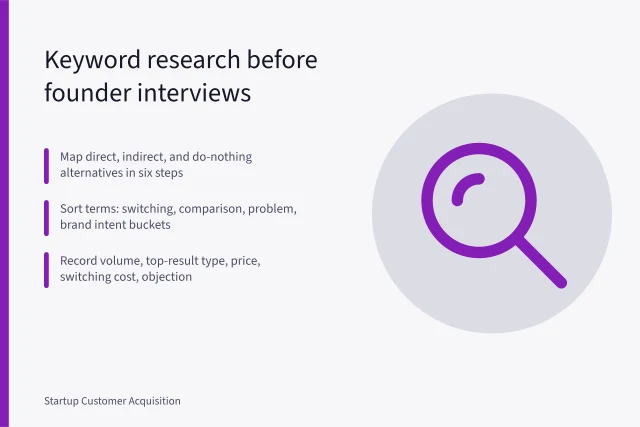
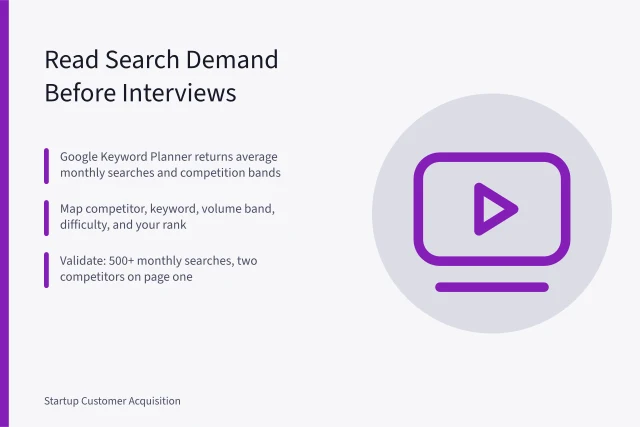
Before you interview buyers, pull demand data so your questions reflect real queries. The method to read search demand before interviews maps competitor keywords into a spreadsheet and turns observed queries into sharper scripts.
Blended vs paid CAC: one table, two answers
Blended CAC spreads every acquisition dollar, including salaries and brand spend, across all new customers. Paid CAC counts only channel spend against customers that channel produced. Report both, and state the window each uses.
Blended CAC answers what the company paid. Paid CAC answers what the channel paid.
Replace every cell below with your own ledger before comparing channels. Payback uses gross profit per customer per month.
| Channel | Monthly spend | New customers | Paid CAC | Payback, months |
|---|---|---|---|---|
| Paid search | $6,000 | 40 | $150 | 5 |
| Paid social | $4,500 | 25 | $180 | 7 |
| Content and SEO | $2,000 | 18 | $111 | 4 |
| Referral program | $1,200 | 22 | $55 | 2 |
| Blended total | $13,700 | 105 | $130 | 6 |
The SBA guide on marketing and sales frames channel level cost decisions for small firms and startups, useful when you decide which channels belong in the paid view.
A five step build order
- Fix the reporting window for the quarter and write it into the file header.
- Pull spend by channel from ad platforms, payroll, and contractor invoices.
- Tag every new customer with source and signup date in one table.
- Compute paid CAC and blended CAC in separate columns.
- Add payback using gross profit per customer, not revenue.
If you want to build a startup CAC model in a spreadsheet, keep one row per channel per month so any reviewer can trace the totals.
Checklist before you trust a benchmark
- The spend window and the customer window match exactly.
- Salaries, tools, and agency fees are either inside or outside, never mixed.
- Free signups and paid signups are separated.
- Refunds, chargebacks, and churned accounts are deducted.
- The source table is saved with the report.
Example: a 12 month payback test
Take the blended row above. Spend of $13,700 produced 105 customers, so blended CAC is $130. If gross profit is $26 per customer per month, payback is five months. A cash pool of $50,000 funds about 385 customers before profit has to recycle.
Run the same arithmetic per channel, then compare blended vs paid CAC to see which view a board will question first.
Cohorts, windows, and seasonality
Signup month is the cleanest cohort key. Group customers by the month they first paid, then attach the spend from that month and the two months before it.
Seasonal demand shifts conversion rates, so a December cohort and a June cohort rarely share a CAC. Keep 90 days of history before setting a target, and mark any cohort still maturing.
Common questions
What counts as a new customer in CAC?
Only customers who started paying or signed a contract inside the window. Trials without billing sit on a separate line.
Should salaries sit inside paid CAC?
Keep salaries in blended CAC and out of paid CAC. That keeps channel comparisons clean while total cost stays visible.
How long should the window be?
One month works for spend, but use a 90 day cohort for payback. Short windows reward channels with fast conversions.
Do public benchmarks replace my own data?
No. Public figures set a range and expose impossible numbers, but your ledger is the only defensible source.