Strategy
Why Austin's tech scene tests innovative pricing models
Austin tech scene pricing models run on usage, seats and hybrid tiers, shaped by local talent, capital and cost pressures that founders test early.
What to take away
- Austin tech scene pricing models cluster around usage, seats and hybrid tiers, and founders test them earlier than peers in most US markets.
- Austin-based B2B SaaS startups push through seat-to-usage conversions first, because their buyers are technical and will audit metering.
- Austin creator economy startups test platform fees, subscriptions and sponsorship tiers against a smaller, denser base of local creators.
- Local market dynamics, including talent churn, capital supply and office costs, decide which pricing experiments are affordable.
- Revenue model design implications travel: the tests that work in Austin usually work in Denver, Raleigh and Miami with adjustments.
Why Austin's B2B SaaS and creator startups run pricing experiments
Austin is a mid-size tech market with a large engineering base and a young founder population. That combination lowers the cost of running a pricing test. A founder can recruit ten design partners within a week and get real usage data before committing to a public price.
The city also has a steady inflow of companies relocating from California. Those teams arrive with existing contracts and pricing pages, so local founders can compare notes against live examples rather than theory. The result is a market where pricing is treated as a product surface, not a finance afterthought.
Austin-based B2B SaaS startups tend to sell to developer, data and operations buyers. Those buyers ask for metered billing, overage rules and spend caps in the first sales call. Founders respond by building usage meters early, which makes later pricing tests cheap.
Austin creator economy startups face a different constraint. Their supply side is creators, and creators compare take rates across platforms within an afternoon. Any pricing change is public and immediate, so experiments have to be small and reversible.
Both groups share one habit: they ship a price change, watch retention for two billing cycles, then decide. That cadence is faster than the annual pricing review common in older software markets.
Pricing model experiments visible in the Austin tech scene
Three experiments show up repeatedly in Austin.
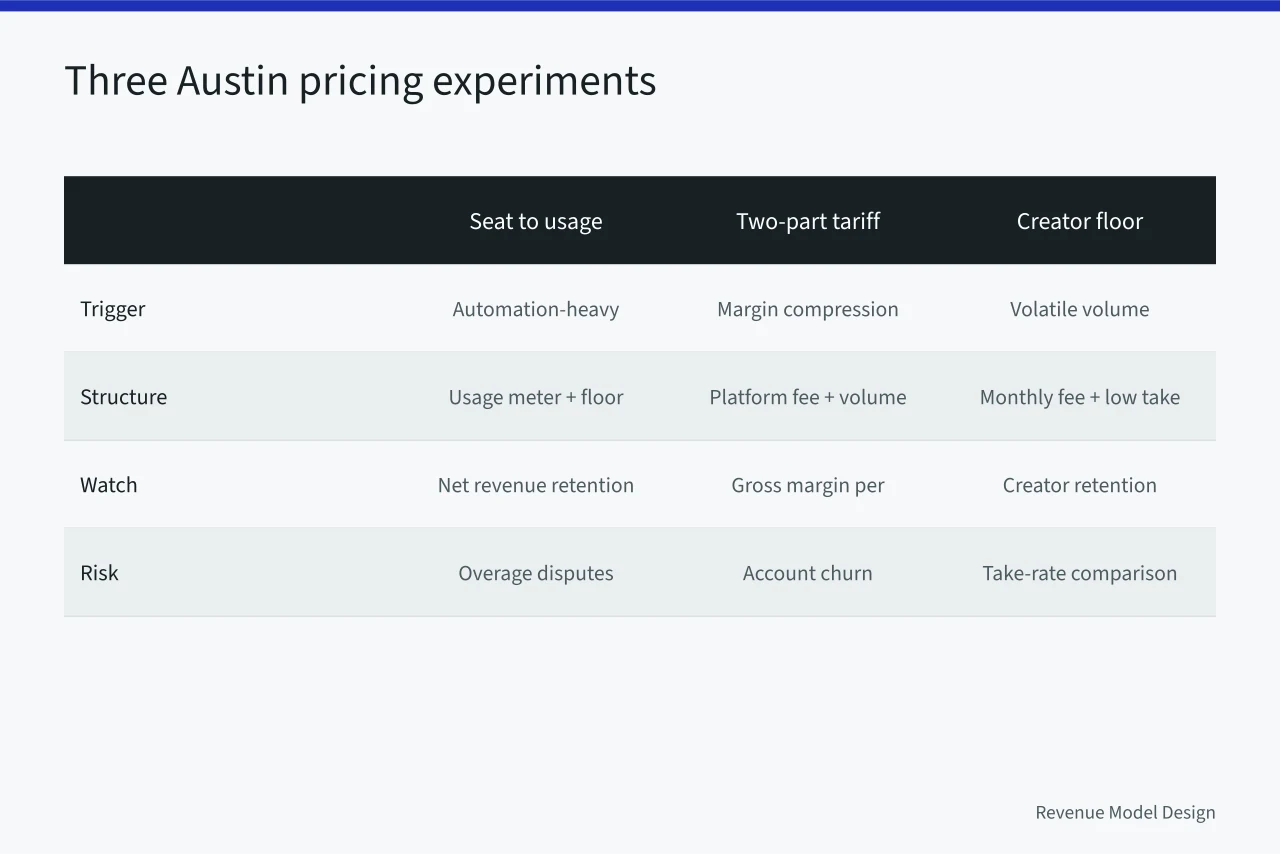
The first is the seat-to-usage conversion. A team sells per seat for a year, then moves heavy users to a usage meter with a committed floor. The goal is to stop penalizing customers who add automation and stop subsidizing customers who add people.
The second is the two-part tariff with a platform fee. A flat monthly platform fee covers support and onboarding, and a variable component covers volume. When one Austin company moved to that structure, its smallest accounts paid more and its largest accounts paid less per unit, which stabilized gross margin.
The third is the creator revenue share with a subscription floor. Instead of taking a percentage of every transaction, the platform charges creators a monthly fee and a lower take rate. Creators with predictable volume prefer it, and the platform gets revenue that does not swing with a single viral month.
| Experiment | Trigger | What founders watch |
|---|---|---|
| Seat to usage conversion | Automation-heavy accounts | Net revenue retention, overage disputes |
| Two-part tariff | Margin compression | Gross margin per account, churn |
| Creator subscription floor | Volatile transaction volume | Creator retention, take-rate comparison |
A worked example helps. Suppose an Austin analytics startup charges $40 per seat with 200 seats, or $8,000 a month. Half the accounts run automated pipelines that consume far more compute than a human user. The team introduces a $2,000 platform fee plus metered compute at cost plus margin.
Accounts below the median pay roughly the same. Accounts above it pay 30 to 50 percent more, and the company stops losing money on its best customers.
That kind of change is a pricing architecture decision, not a discount decision. It resets who pays and for what.
How local market dynamics shape revenue model design
Austin's market dynamics push pricing toward transparency. Buyers here are technical, and many have seen metered billing done badly at previous employers. They ask for usage dashboards before they sign.
Competition is another factor. Austin companies compete with vendors in San Francisco, Seattle and New York for the same buyers, but they rarely win on brand. They win on price clarity and fast onboarding, which makes a simple pricing page a sales asset.
Capital supply matters too. Austin has a deep seed market and a thinner late-stage market. Companies that cannot raise a large Series C need revenue earlier, so they favor pricing that collects cash in month one rather than year two.
The creator side is shaped by density. Austin has a concentrated community of video, podcast and newsletter creators, plus the agencies that represent them. Word travels fast, so a take-rate change is common knowledge within days. Platforms respond by publishing rate cards and grandfathering existing creators.
Federal rules sit underneath all of this. Revenue recognition under FASB standards affects how subscription and usage revenue is booked, and the SEC governs what public competitors must disclose. Private Austin startups still feel those rules indirectly through investor expectations.
Owners also protect the pricing itself. A distinctive tier name or meter brand can be registered, and the trademark basics process is the usual route. Pricing mechanics that are genuinely new can be pursued through patent protection, though most Austin teams treat that as optional.
Talent, capital and cost pressures behind Austin pricing choices
Austin salaries for senior engineers have risen for a decade, and remote work means local companies compete with national pay bands. That cost pressure shows up directly in pricing: a company with a high cost per engineer needs higher revenue per account.
Office and operating costs are lower than San Francisco or New York, which gives Austin founders room to run a low-price experiment without burning the company. That is a real advantage. A pricing test that fails in Austin costs less than the same test in a coastal market.
Capital is available but selective. Investors here ask about gross margin and payback period early, which pushes founders toward usage-based pricing and annual commitments. Those structures produce cleaner unit economics, and they expose bad ones faster. Most of the mistakes show up on the input side, not in the arithmetic, as we covered in usage-based pricing model design.
Labor data helps. Federal cost statistics, including the BLS overview of business costs, give founders a baseline for compensation and overhead when they model price floors. The BLS business leader resources are useful for the same reason during annual planning.
For companies just forming, the USAGov small business hub covers registration, licenses and the basics of setting up a revenue-generating entity in Texas.
What Austin founders test first when usage-based pricing stalls
Usage pricing stalls for predictable reasons. Customers cannot forecast spend, procurement blocks the contract, or the meter is too complex to explain. Austin founders run a short checklist before abandoning the model.
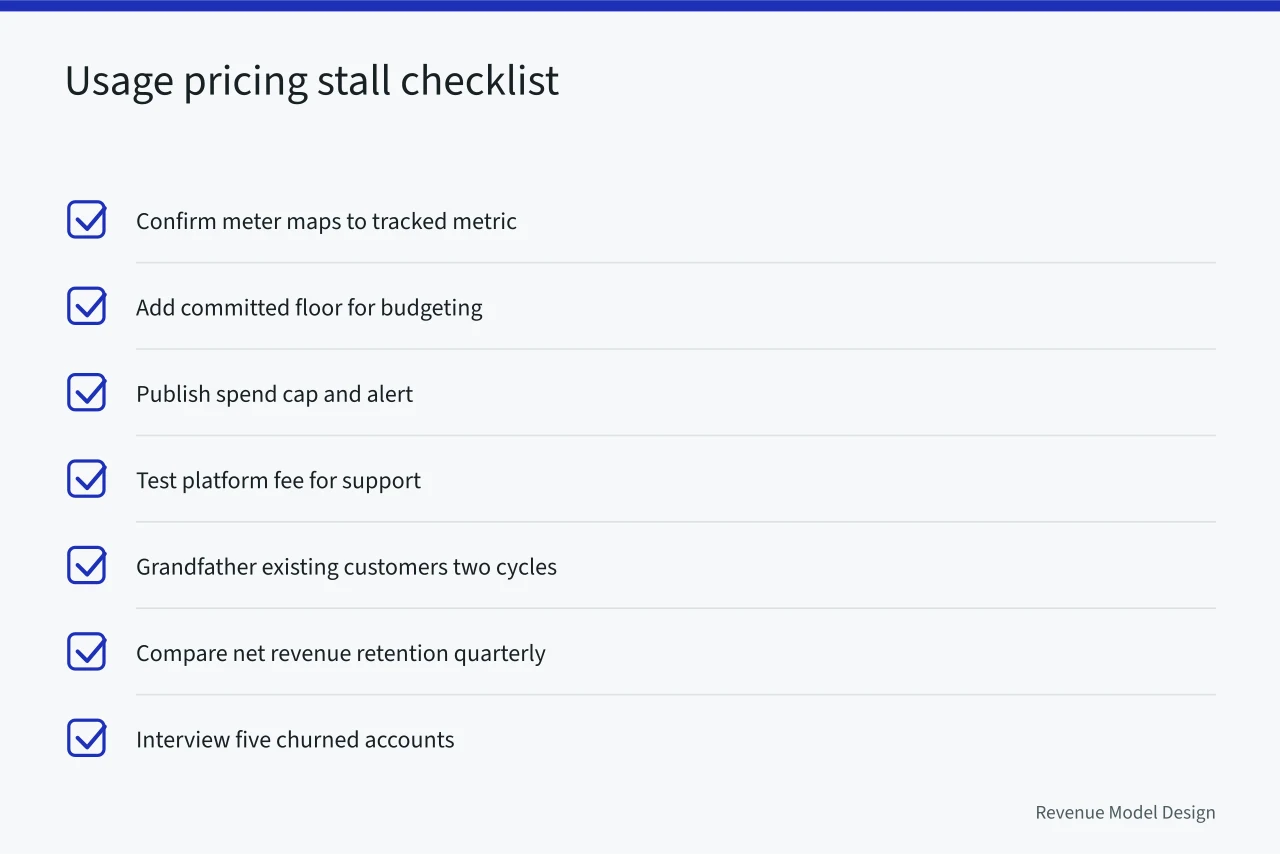
If the checklist fails, the next move is usually a hybrid: a subscription base plus a usage component. That is a revenue model choice with real consequences for sales compensation, because reps now sell a floor and a ceiling.
A second fallback is to change the buyer. Some Austin startups move from team-level pricing to department-level pricing, which raises contract value and reduces the number of invoices. The product does not change. The unit of sale does.
A third fallback is to keep usage pricing but sell it as a pilot. The customer commits to a fixed fee for 90 days, then converts. This gets past procurement and produces real usage data, which is the point of the experiment.
Whatever the outcome, the useful discipline is to separate the pricing change from the product change. Teams that do both at once cannot tell which one moved retention. Austin founders who run this cleanly tend to keep the practice as they scale, treating pricing as continuous model innovation rather than a one-time project.
Lessons from Austin pricing experiments for other markets
Austin's advantage is not unique technology. It is a market small enough to test in and large enough to matter. Founders in Denver, Raleigh, Miami and Salt Lake City can copy the method without copying the prices.
Start with a segment you can reach directly. Austin founders often begin with local design partners because the feedback loop is short. Any mid-size tech market supports the same move.
Keep the experiment narrow. One segment, one metric, two billing cycles. Broad pricing overhauls produce ambiguous results and angry customers.
Write down the trigger for reversing the change before you ship it. Austin teams that do this recover faster when a price increase hits retention harder than expected.
Expect the local cost base to set your floor. A market with high engineering salaries needs higher revenue per account, and a market with cheap office space can afford a longer payback period.
Finally, treat pricing as a local advantage. A company that can run four clean pricing tests a year learns more about its buyers than a competitor that runs one. That learning compounds, and it is available in any city where founders are willing to ship a price change and watch what happens.
Common questions
Why does Austin test pricing models more often than other tech hubs?
The market is small enough to recruit design partners quickly and large enough to produce meaningful data. Founders also face national competition, which rewards price clarity over brand.
What is the most common pricing experiment in Austin B2B SaaS?
The seat-to-usage conversion, usually with a committed floor and a published spend cap. It addresses accounts that consume far more than they pay for.
How do Austin creator economy startups price differently?
They lean on subscriptions and platform fees rather than pure transaction take rates, because creator income is volatile and creators compare take rates publicly.
Do federal rules affect Austin pricing decisions?
Yes. Revenue recognition standards shape how subscription and usage revenue is booked, and SEC disclosure rules set expectations for investors comparing private companies to public ones.
When should a founder abandon usage-based pricing?
When customers cannot forecast spend, procurement will not sign, and the meter cannot be explained in one sentence. A subscription base with a usage component is the usual fallback.