
Costs
Part of Mapping alternatives is real market research, done before any interview
How startups run market research on a budget
Budget market research for startups pairs cheap tools with a written decision, so founders learn what buyers do before they spend on a build.
What to take away
- Write the decision, the owner and the evidence threshold before you pick a market research method, or the study cannot change anything.
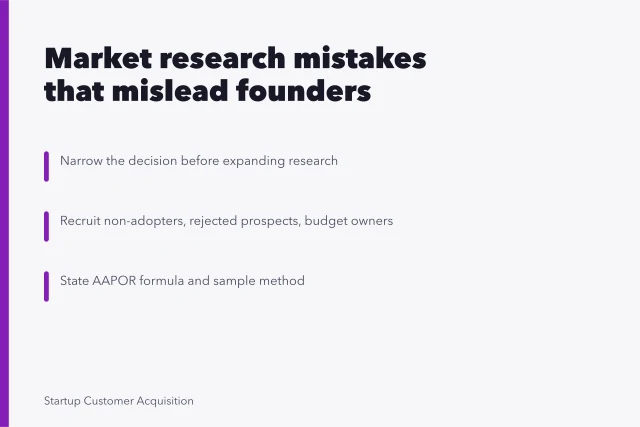
- Recruit non-adopters and rejected prospects, not just friendly users, because contradiction is the cheapest finding you will get.
- Cheap tools do the workGoogle Analytics 4, Tally, Otter.ai, Prolific, and free Census data files.
- Keep a one-page memo per cycle with sources, limits and a review trigger, so the next hire can audit the call.
- Disclose the method and protect participants; AAPOR's transparency rules and your state's privacy law both apply.
An agency-led market research study typically runs $10,000 to $50,000. Running Startup market research on a budget is not a smaller version of that. It is a written decision, a cheap instrument that can change it, and a memo that survives the founder who commissioned it.
Name the decision before you name the method
Write the choice, the alternatives, the owner and the date. Add the evidence threshold: what result would flip the call. A study that cannot flip anything is a reading list. This step costs two hours in a shared doc.
Decision Brief Checklist
- Write the choice and alternatives
- Name the owner and date
- Set evidence threshold that flips call
- Translate assumption into observable behavior
- Check existing GA4 events
Then translate each assumption into something observable. "Buyers want faster onboarding" becomes "buyers abandon setup before the first invoice." The second version can be checked with data you already own, often in Google Analytics 4 events nobody has opened.
The budget stack, by price
Cost
- Google Analytics 4 (free tier)
- $0
- Microsoft Clarity
- $0, session recordings without a time limit
- Tally or Google Forms plus a paid panel
- Tally's free plan caps no submissions; panels run $0 to $50 per wave
- Prolific sample
- Typically $8 to $12 per participant hour plus a platform fee
- Recorded customer calls on Zoom or Google Meet
- $0, with 40 to 60 minute free-call limits
- Otter.ai transcription
- $0 for about 300 minutes a month
- Census and BLS data
- $0
- Google Trends and SparkToro
- $0, SparkToro's free tier is about five searches a month
- UserTesting or Maze
- Maze's free tier covers basic tests, paid plans start around $99 a month; UserTesting quotes per study
- Respondent.io or User Interviews
- Per-interview fee, typically $50 to $250 incentive plus a platform fee
- LinkedIn Sales Navigator
- About $99 a month billed annually
What it answers
- Google Analytics 4 (free tier)
- Where users actually stop
- Microsoft Clarity
- Where visitors get stuck on the page
- Tally or Google Forms plus a paid panel
- Stated preference at small n
- Prolific sample
- Counts from a general population
- Recorded customer calls on Zoom or Google Meet
- Language, objections, workarounds
- Otter.ai transcription
- Searchable quotes from those calls
- Census and BLS data
- Market counts and wage structure
- Google Trends and SparkToro
- Search demand and where buyers read
- UserTesting or Maze
- Task-level usability
- Respondent.io or User Interviews
- Hard-to-reach job titles
- LinkedIn Sales Navigator
- Finding and screening people to interview
Run the free rows first. Most startup questions die there, and the paid rows are for the ones that survive. A three-interview cycle with consumer participants typically lands between $150 and $400 once incentives and platform fees are counted.
Free vs Paid Research Tools
Free tools
- Analytics
- GA4 $0
- Recordings
- Clarity $0
- Surveys
- Tally free
- Interviews
- Zoom $0
- Recruiting
- Reddit time
- Transcription
- Otter 300 min
Paid tools
- Analytics
- Maze from $99/mo
- Recordings
- UserTesting quote
- Surveys
- Panel $0-$50
- Interviews
- Respondent $50-$250
- Recruiting
- Sales Nav $99/mo
- Transcription
- —
Free tiers have edges worth knowing. Otter.ai's free plan covers about 300 transcribed minutes a month, roughly ten half-hour calls. Clarity and Google Forms cost nothing on a personal Google account.
Recruit people who disagree
Interview buyers, users, non-adopters, rejected prospects and former customers. Log the source, eligibility, incentive and who is missing. If everyone you talk to already likes the idea, you have collected compliments, not evidence.
Who to Recruit for Interviews
Do you only hear agreement?
compliments, not evidence
include buyers, users, non-adopters, rejected prospects, former customers
Recruiting is the line item founders forget. A $25 gift card covers a 30-minute consumer interview. Specialist titles found through LinkedIn Sales Navigator, about $99 a month billed annually, typically need $100 to $200. Reddit communities and your own churned-customer list cost time instead of money.
Ask about the last real event. Cover the trigger, the steps, the tools, and the money. Also cover the approval and the outcome. Skip hypothetical willingness. A market research checklist keeps the trigger and the artifacts from each interview in one file.
Disclose the method and protect the people in it
State the sponsor, the instrument, the sample source, the dates and the limits. AAPOR's Transparency Initiative asks for routine method disclosure and notes that participation is not a quality badge, so inspect the method rather than the logo.
Method Disclosure Checklist
- State sponsor and instrument
- Name sample source and dates
- List limits of the study
- Explain data use and retention
- Tell participants how to withdraw
- Keep research separate from promotion
Tell participants how you will use the data, how long you keep it, and how they withdraw. Minimize personal data and keep research separate from promotion. For anything touching privacy law, name your regime and ask counsel; the NIST Privacy Framework is a voluntary risk process, not legal clearance.
Leave a trail a stranger can follow
After each cycle write one page. Include these items: source, date, method, segment. Also include quote context, contradiction, confidence, decision. Set a review trigger for a new segment, price, channel or competitor move. Refresh only the assumptions that trigger touches.
Preserve the old instrument. If the number moves, you need to know whether the market changed or the questionnaire did. Startup market research benchmarks are only usable when you can see the file behind them. A free Notion or Google Docs page holds the memo, and a shared drive keeps every retired form.
Common questions
What does budget research cost in practice?
Most early questions cost nothing but calendar time, because Google Analytics 4 and recorded calls already hold the answer.
Budget $0 to $50 per survey wave on Tally or Google Forms, and a per-interview fee only for titles you cannot reach otherwise. Twelve five-minute Prolific responses equal one participant hour, about $8 to $12 plus the platform fee. If you are unsure which startup market research questions come first, start there before you spend anything.
When is a paid panel worth it?
When you need a defined count from a population you cannot reach, and when the decision would change at a specific number. If no number would change your mind, do not buy the sample. UserTesting and Respondent.io sell access to respondents, not answers.
How do I keep participant data safe?
Limit collection to what the decision needs, restrict access, and set a deletion date. CISA's logging guidance covers event records for security review, not research quality.
How often should I rerun a study?
Rerun when a trigger fires: new geography, segment, price, regulation or major competitor move. Otherwise leave the finding alone and spend the budget on the next decision. A second wave of the same instrument costs about what the first one did, so fix the trigger before you pay.