Strategy
Competitor keyword research before interviews: mapping alternatives as real market research
A repeatable public-data method for mapping competitor alternatives and switching keywords before interviews, with tools and acquisition tests to run.
What to take away
- A competitor alternatives map lists every option a buyer weighs, including spreadsheets, agencies, and doing nothing.
- Public keyword data gives you prices, obligations, and complaint themes before you schedule a single interview.
- Keyword gap analysis shows which terms rivals rank for and you do not, sorted by commercial intent.
- The map becomes your interview script, your ad copy, and your positioning brief.
Why search data precedes customer calls
Interviews are expensive. A 30 minute call with a target buyer costs scheduling time, an incentive, and a week of calendar friction. Before spending that, gather evidence anyone can check: search results, review text, pricing pages, and keyword tools.
Search data is behavioral. People type what they want when they are alone with a browser. A founder asking what would make you switch gets a polite guess. A keyword report shows thousands of people typing a competitor alternative plus a qualifier.
This does not replace talking to customers. It sets up the conversation. Mapping alternatives is real market research, done before any interview, and the memo you write afterward lists the open questions.
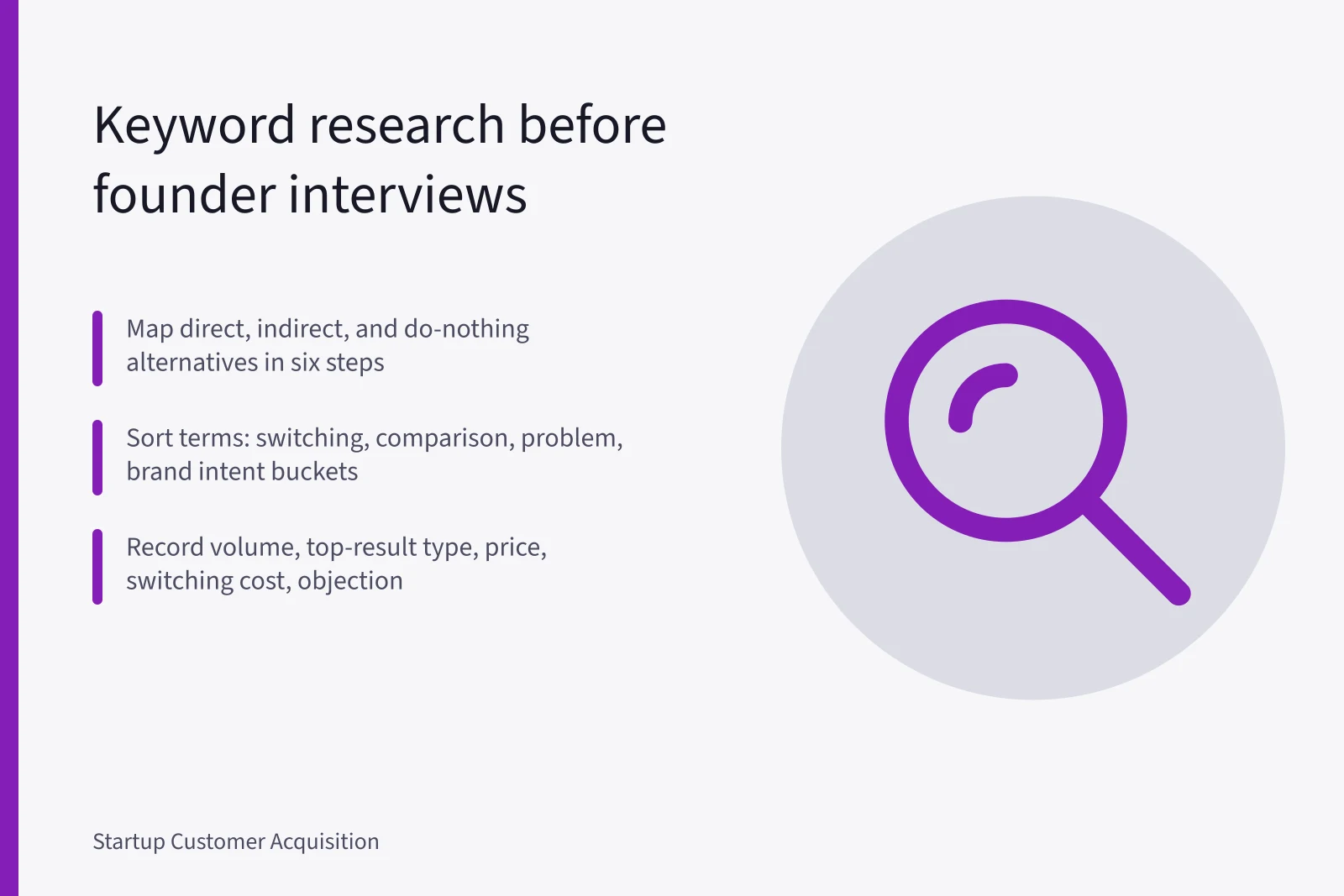
Building the alternatives map in six steps
Building the alternatives map
- List direct competitors. Take the five tools a buyer would shortlist, plus the incumbent everyone uses and dislikes.
- List indirect alternatives. Spreadsheets, agencies, freelancers, internal builds, and the do nothing option.
- Harvest autocomplete and People Also Ask. Try the patterns competitor vs, competitor alternative, competitor pricing, and how to cancel competitor.
- Run a keyword gap analysis. Ahrefs, Semrush, Moz, and Google Keyword Planner show terms rivals rank for that your domain does not. Filter to commercial intent.
- Record volume, difficulty, and the current top three results. Note whether those results are vendor pages, listicles, or forums.
- Save the switching vocabulary. Phrases such as migrate from, export data from, cancel contract, and too expensive map to buying triggers.
Sorting terms by intent and price
| Term type | Example query | What it tells you |
|---|---|---|
| Switching | alternative to X for small teams | Buyer is unhappy and near a decision |
| Comparison | X vs Y pricing | Buyer is shortlisting and price sensitive |
| Problem | how to invoice in two currencies | Buyer has no vendor in mind yet |
| Brand | X cancel subscription | Churn and win-back opportunity |
Sort every term into one of these buckets. Attach a rough cost per lead from your own paid search history, then compare it with customer acquisition cost before promising a channel to anyone.
A competitor alternative search is a buying signal. Treat the query as a request for a price and a migration path, not for a blog post.
What to record for every term
- The exact query and its monthly volume band.
- Whether the top results are vendor pages, listicles, or community threads.
- The price shown on the top three ranking pages.
- The switching cost a buyer would face, such as data export or contract notice.
- The objection you would need to answer in the headline.
Example: a physiotherapy scheduling startup
A two person scheduling tool for physiotherapy clinics built this map in a week. Direct competitors were three booking platforms. Indirect alternatives were paper diaries, a part time receptionist, and a general calendar tool with manual workarounds.
The gap was clear. Rivals ranked for physio booking software, but no page owned the switch from a named rival without losing appointment history. Search volume was small and intent was high.
The team published a migration guide with an export path, a price table, and a support promise. Trials followed within weeks and sales calls got shorter because pricing objections were already handled on the page.
From keyword gaps to acquisition tests
Pick the top ten gap terms. Write one landing page per cluster rather than one per keyword. Every page needs a price, a migration path, and a timeline. Then run a small paid test with a fixed budget and a stop date.
The SBA's market research guidance treats competitor analysis as routine pre-launch work, not a one-time project, which fits a keyword map you keep updating.
The SBA's marketing and sales guide frames channel costs for small teams, useful when you compare paid search against referral programs.