Strategy
Competitor keyword research for startups: how to read search demand before interviews
How to pull competitor keyword and search demand data before customer interviews, map gaps in a spreadsheet, and turn observed queries into sharper scripts.
What to take away
- Competitor keyword research gives founders a numeric baseline before interviews: search volume, difficulty, and where rivals rank.
- Free tools such as Google Keyword Planner and paid tools such as Ahrefs or Semrush produce the raw data; a spreadsheet turns it into a map.
- A keyword gap analysis shows which queries competitors win and you do not, which sizes demand before you write a script.
- Search demand validation replaces opinion with observed queries, so interview questions test real behaviour.
- Run the map first, then connect it to acquisition tests that track cost per signup.
Keyword tools that publish real numbers
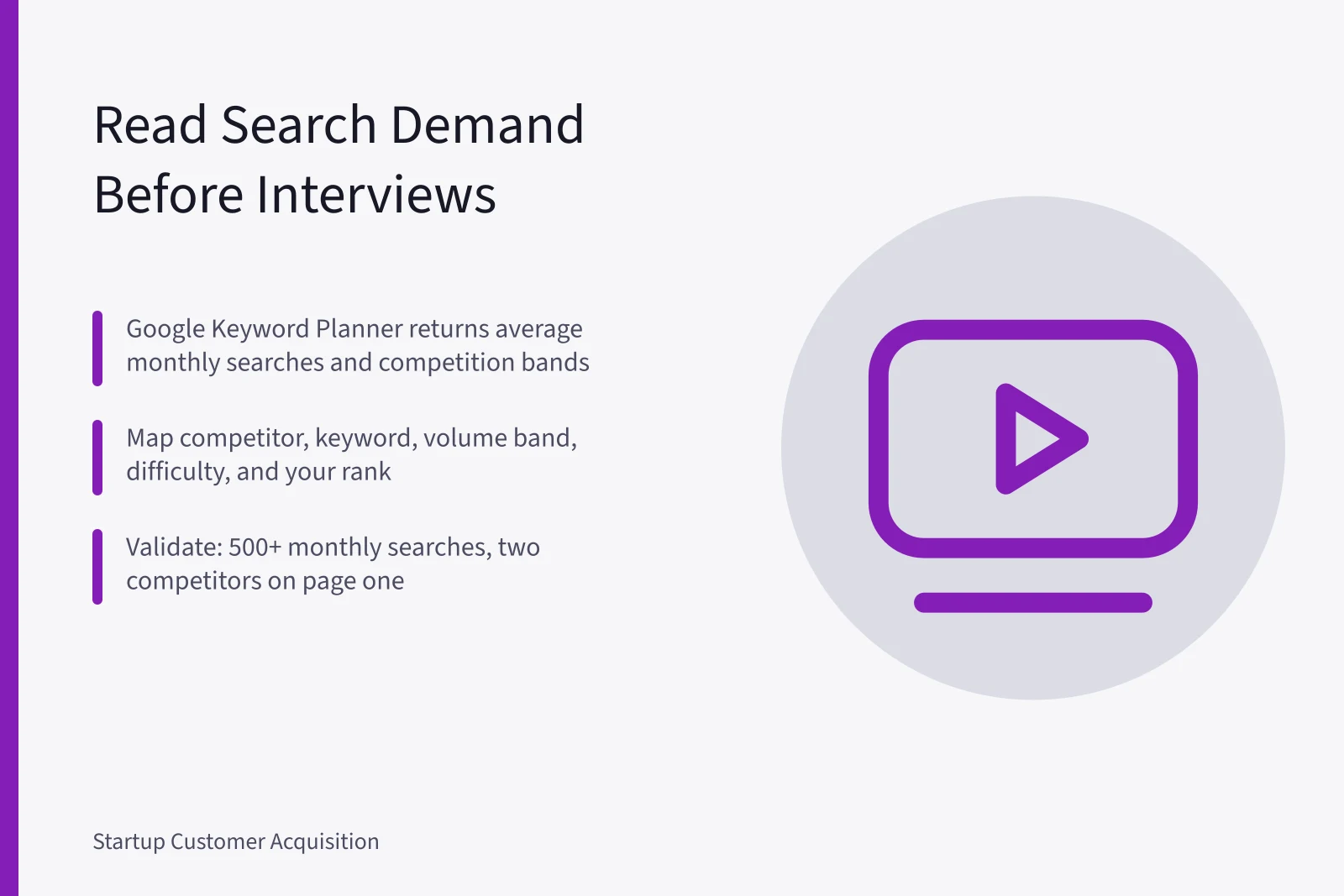
Google Keyword Planner sits inside a Google Ads account and returns average monthly searches plus competition bands. Ahrefs, Semrush, and Ubersuggest sell similar data on subscription. Moz Keyword Explorer is another option.
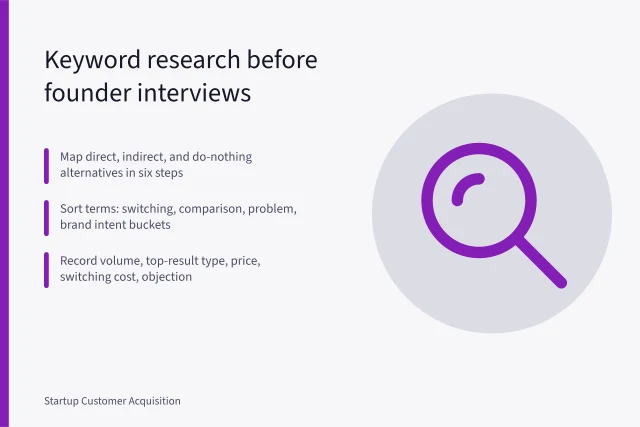
Pull every keyword that mentions a rival brand, a rival category term, or a job the customer is trying to finish. Keep the raw export. You will re-run it after interviews.
The SBA market research guidance covers how to compare community based research with paid acquisition channels.
The competitor keyword map spreadsheet
Set columns for competitor, head keyword, volume band, difficulty, and your current rank. Sort by volume band, then difficulty. Anything above 60 difficulty with no domain authority is a later project.
A simple mapping table keeps the work honest:
Competitor keyword map
| Competitor | Head keyword | Volume band | Difficulty | Your rank |
|---|---|---|---|---|
| Rival A | team scheduling software | 1K to 10K | 42 | none |
| Rival B | shift planning app | 1K to 10K | 38 | 24 |
| Rival C | free rota maker | 10K to 100K | 55 | none |
Then follow these steps:
Building the keyword map
- Export keyword lists from your two closest competitors with Ahrefs Site Explorer or Semrush Domain Overview.
- Remove branded terms you cannot legally bid on in some regions.
- Tag each remaining keyword by intentcompare, switch, price, or problem.
- Save the file and date it. Re-run the export monthly.
Search demand validation checklist
Use a checklist to confirm a keyword is worth an interview slot:
- Volume band is at least 500 average monthly searches in your target country.
- At least two competitors rank on page one for the term.
- The query implies a purchase or switch decision, not idle curiosity.
- Your product can answer the query without a new feature.
Search demand validation is not a replacement for interviews. It tells you which questions to ask first, and which to skip.
Example: a scheduling startup keyword gap
A two-person scheduling startup mapped 180 keywords. Rivals ranked on page one for "shift swap app" and "rota template". The startup ranked for neither.
A keyword gap is a queue of questions the market is already asking. Interviews only refine the answer.
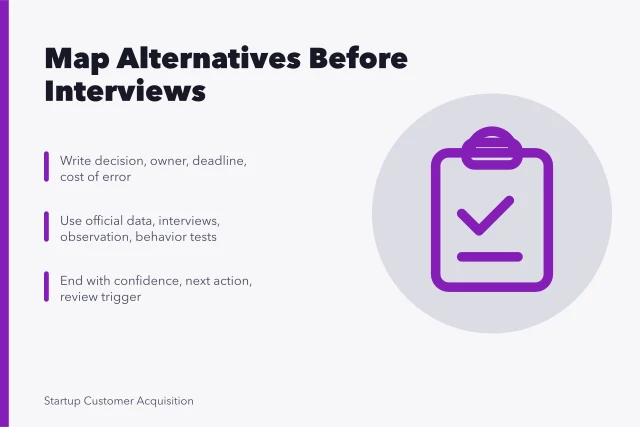
Instead of asking whether shift swaps were painful, the founders asked how people currently swap shifts, how long it takes, and what they pay for tools today. Those answers map directly to switching pages you can publish later. The full method, including how to map alternatives and switching terms, lives in mapping competitor alternatives.
Interview scripts built from keyword clusters
Interview questions built on keyword data are sharper. Write one question per keyword cluster.
Interview scripts from clusters
- For comparison keywords, ask what alternatives the person evaluated and why they rejected each.
- For switching keywords, ask what triggered the change and what blocked it.
- For price keywords, ask what they currently pay and what counts as too expensive.
Record answers in a sheet next to the keyword. Over ten interviews, patterns appear in the language customers use. That language becomes your positioning hypothesis and your ad copy.
Cost matters here. Track cost per signup by channel before you scale, using the channel-level framing in the SBA marketing and sales guide. Compare it with lifetime value, defined in the customer acquisition cost overview.
Once the script works, plan the build with a keyword gap analysis workflow and test pricing pages early.