Reviews
Part of Mapping alternatives is real market research, done before any interview
Best startup market research tools: a ranked shortlist with reasons
A ranked shortlist of startup market research tools, judged on reproducible outputs, exportable evidence, clean exit and pricing transparency.
What to take away
- Rank a tool by whether a second operator can reproduce its output from saved settings.
- Census Business Builder and BLS OEWS answer geography and wage questions; neither proves demand.
- Google Trends compares relative attention only, never volume or customer count.
- Typeform, Qualtrics and Dovetail are judged on consent, exports and deletion, not question libraries.
- Keep the smallest toolset that leaves a defensible research record.
Startup market research tools get picked for a decision, not a feature list. A trend chart, a survey platform and an interview recorder do different jobs.
No tool repairs a vague market, a biased sample or a leading question.
How this shortlist is ranked
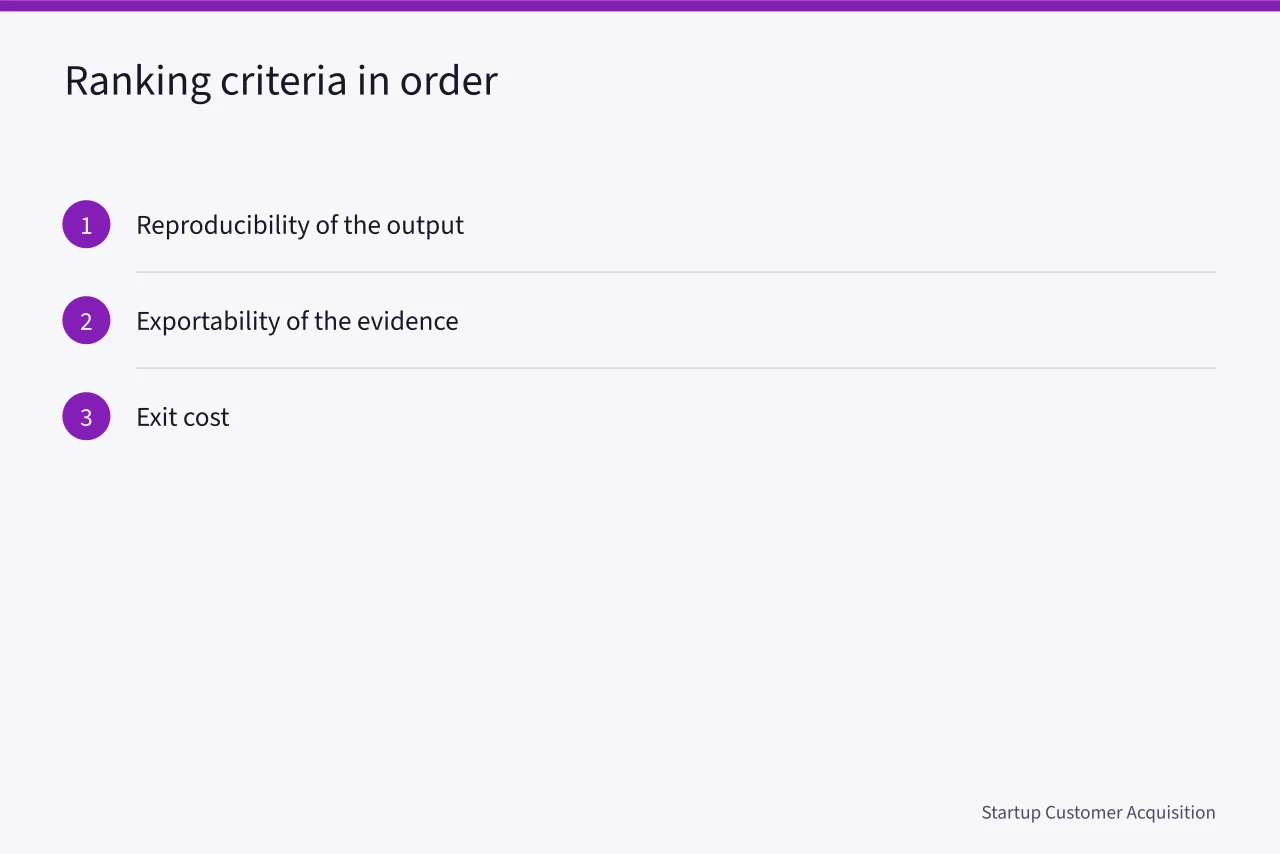
Ranking criteria, in order: reproducibility of the output, exportability of the evidence, and exit cost. A tool that fails reproducibility cannot support a material decision no matter how good its charts look.
Pricing below is the vendor's public model as of 2026; confirm current terms on the vendor's own page. Each entry states what the tool answers and why it placed where it did.
1. Census Business Builder
The Census Bureau's free explorer frames population, industry, location and employer questions through maps and downloadable tables. It ranks first because every exported value traces to a named survey, period and geography. Inspect the original field, unit, classification and revision before you cite a number.
2. BLS Occupational Employment and Wage Statistics
OEWS covers occupation, employment, wage, industry and location. It is free and public. It does not prove product demand, applicant availability or willingness to pay. Preserve the dataset definition and measured period, because startup market research questions about demand still need direct evidence.
3. Google Trends
Trends compares relative attention across queries, topics, time and place. It is free and needs no account. Save the settings and the export. A normalized index is not exact volume, representative opinion or a customer count.
4. Typeform
Typeform ranks fourth for cheap entry and clean response exports. It suits short screening surveys on a per-response plan, with a free tier that caps monthly responses. Paid self-serve plans typically start under $50 per month as of 2026, billed monthly or annually.
Like any survey tool, it carries recruiting, screening, consent and scheduling, plus recording, transcription, exports, permissions and deletion. Compare those mechanics, not the question library.
5. Qualtrics
Qualtrics suits regulated research with role-based access, which is why it ranks above the per-response tools for controlled studies. Enterprise contracts are quoted annually, typically in the thousands of dollars per year as of 2026, so its pricing is less transparent than Typeform's.
6. Dovetail
Dovetail suits qualitative repositories: recordings, transcripts and coded notes in one place. It ranks sixth because exit cost is the risk when a study ends. A free tier covers small projects; paid seats are typically in the tens of dollars per seat per month as of 2026. Confirm that recordings and identity delete cleanly before you upload.
7. Notion and Airtable
A controlled spreadsheet or a research repository such as Notion or Airtable links each decision to its source, method, date and confidence. It ranks last because it stores evidence but generates none. Restrict personal data, separate identifiers from analysis, and keep version history. Never upload confidential records into unapproved tools.
Test a labor-data API outside its interface
The Bureau of Labor Statistics public data API guide documents versioned access, series requests, parameters and registration conditions. Save the series IDs, request, period, response and access date. Reproducibility starts there.
Compare another official API's structure
The Bureau of Economic Analysis web service API user guide documents methods, parameters, datasets, results and errors. Run one small representative query to test metadata, limits, export and recovery before you depend on it.
Run a tool test
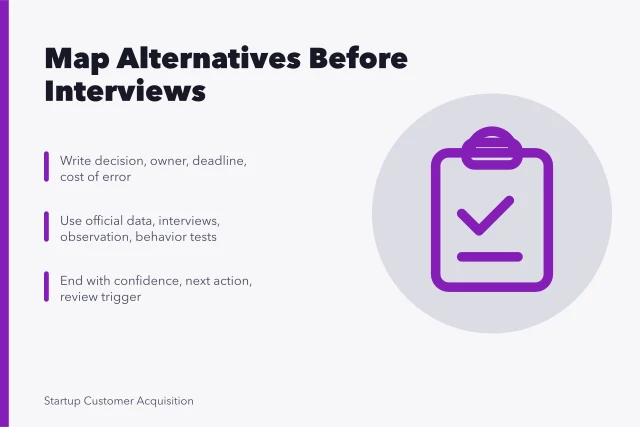
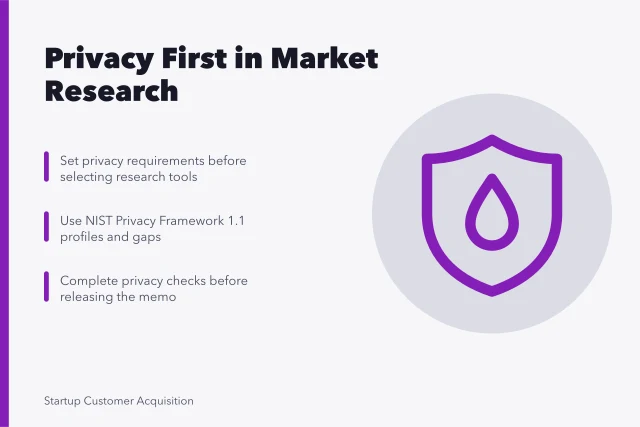
Use one small approved study to exercise setup, collection, export and reproduction. Then test failure recovery, permission removal and deletion. Score evidence quality, operator effort, total cost, participant experience and exit. A market research checklist puts privacy requirements first, before any tool collects participant data.
Repeat one calculation outside the interface. If two operators cannot reproduce the same output from the saved settings, the tool needs better documentation before it supports a material decision.
Quick comparison
| Tool layer | Pass test | Exit test |
|---|---|---|
| Census Business Builder / BLS OEWS | Query reproduces with metadata | Export remains readable |
| Typeform / Qualtrics | Logic and disposition export | Instrument and raw data export |
| Dovetail | Notice and context are preserved | Recording and identity delete |
| Notion / Airtable | Decision traces to evidence | Permissions revoke cleanly |
Test the operating burden
The GOV.UK technology selection guidance recommends adaptable choices, data control, security review and ownership-cost analysis. Those public-service questions apply to commercial tools; they are not endorsements.
The GOV.UK open standards guidance links open standards with interoperability and reduced supplier dependence. Test whether startup market research data and definitions can move between tools.
Common questions
Which startup market research tool is best?
It depends on the evidence task. Census Business Builder wins on geography, OEWS on wages, Trends on attention, and a survey platform on direct demand evidence. Pick the layer that closes your gap.
What do these tools cost?
Census Business Builder, BLS OEWS and Google Trends are free. Typeform's paid self-serve plans typically start under $50 per month as of 2026. Qualtrics quotes enterprise contracts annually, and Dovetail charges per seat with a free tier.
Should one platform hold all research data?
Only if its permissions, retention and deletion model covers every record you put in it. Mixed data classifications usually need more than one store.
How should a tool be tested?
Run one small approved study through setup, collection, failure, export, reproduction and deletion. If two operators cannot reproduce the output, the tool fails.
Do free public tools replace paid research?
No. Public data frames the market; it rarely proves that a specific buyer will pay. Pair it with interviews or a survey.