Careers
Part of Mapping alternatives is real market research, done before any interview
Which startup market research trends to watch
Startup market research trends for 2027 include API access, disclosed AI assistance, scrutiny of synthetic responses, query context, and separation from marketing.
What to take away
- Treat trends as operating signals to test, not guaranteed forecasts.
- Faster data access raises the value of provenance, definitions, versioning, and reproducibility.
- AI-assisted or synthetic material must remain distinguishable from evidence gathered from real people.
Startup market research trends for 2027 are signals to test rather than predictions. Current standards and data tools point toward more artificial-intelligence assistance, greater method disclosure, updated public-data interfaces, continuous evidence systems, and sharper separation between research and marketing.
Expect more research through public APIs
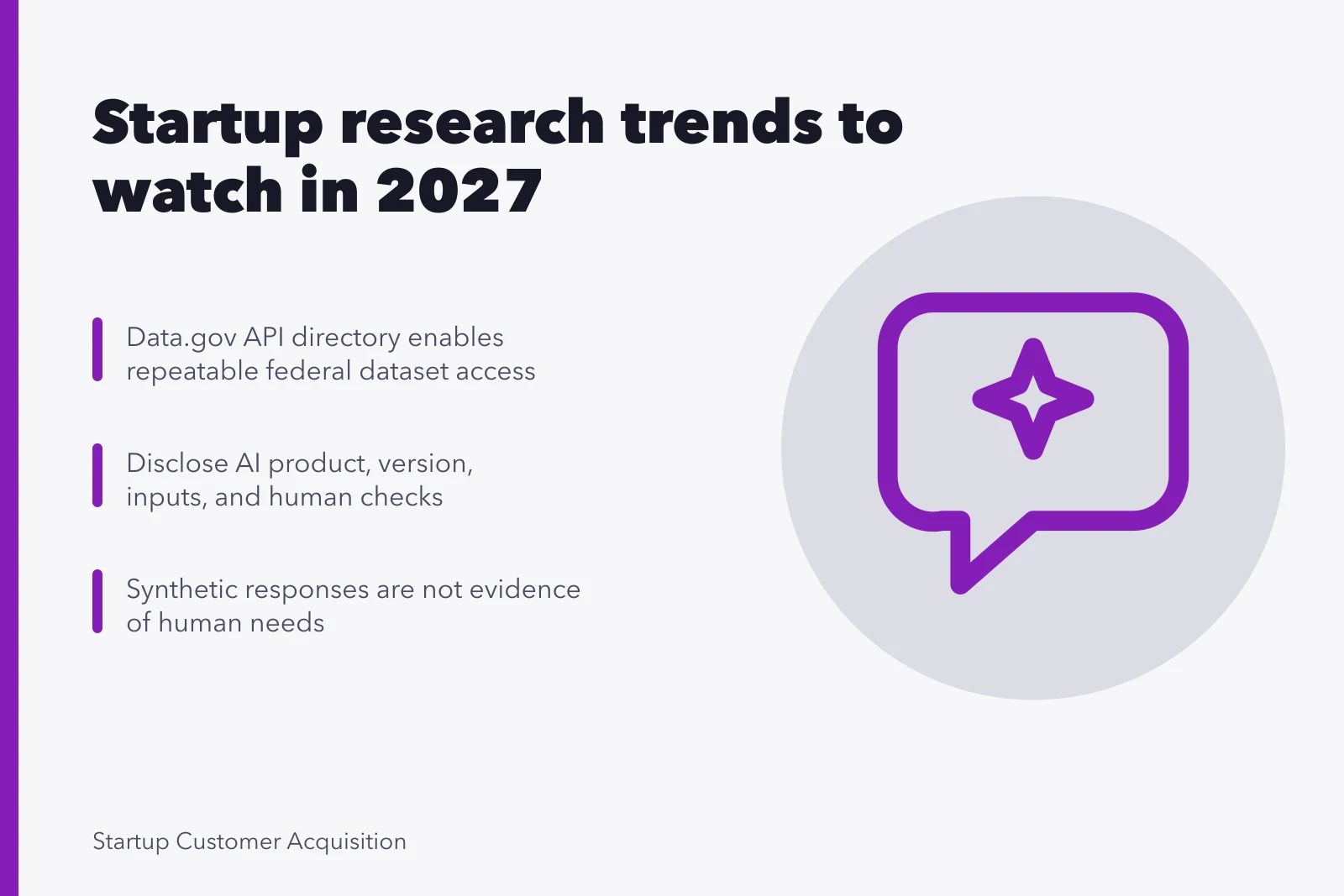
Data.gov's API directory for developers points to federal dataset APIs and documentation. API access improves repeatability only when teams save the endpoint, parameters, version, response date, definitions, errors, and transformation steps.
AI assistance becomes a disclosed method
Teams may use AI for recruiting support, prompts, transcription, translation, coding, synthesis, or questionnaire review. Record the product, version, inputs, human checks, corrections, data handling, and which records came from real people. Do not present generated material as participant evidence.
Synthetic responses face stronger scrutiny
Generated personas, synthetic responses, and simulated markets may help brainstorm methods or test software, but they are not automatically evidence of human needs, prevalence, authority, or willingness to pay. State the validation population and known limits.
Public data becomes easier to explore
Public-data publishers continue to expand interfaces, downloads, and APIs. Easier access can broaden research, while every startup still needs to inspect the dataset, measured period, classification, unit, revision, uncertainty, and applicability. Before trusting any downloaded dataset, teams should review common startup market research questions about timing, units, and evidence quality.
Search signals require better interpretation
Search and attention tools make relative movement easy to explore. Teams should expect stronger demands for saved queries, settings, comparison terms, exports, access dates, and corroborating behavior rather than screenshots without method context.
Research becomes a continuous operating record
Instead of a one-time market report, startups can connect support, sales, churn, product use, interviews, competitor records, and official releases to dated assumptions. The opportunity is faster correction. The risk is collecting too much personal information or confusing platform activity with representative market evidence.
Research and direct marketing separate more clearly
Genuine research and promotional contact can trigger different expectations and rules. Define the purpose, message, follow-up, participant expectation, personal-data use, and applicable jurisdiction before collection, and obtain current advice where needed.
Prepare a 2027 method log
For every new method, record decision, population, human and synthetic sources, recruitment, instrument. Record tools, processing, privacy controls, limitations, and validation.
The durable trend is clearer evidence about an answer's origin and what decision it can responsibly support, not faster answer production, and a startup market research checklist keeps privacy controls and validation steps in the same dated record.
Quick comparison
Required record
- Public APIs
- Request, version, definition
- AI assistance
- Tool, input, human check
- Continuous log
- Assumption and trigger history
- Research boundary
- Purpose and follow-up
Risk
- Public APIs
- Fast but misread data
- AI assistance
- Generated material presented as evidence
- Continuous log
- Unlimited data retention
- Research boundary
- Unexpected promotion
Separate genuine research from promotional contact
The UK ICO's guidance on identifying direct marketing distinguishes genuine market research from contact that includes promotional material or seeks marketing consent. Apply the current UK context and seek advice for other markets.
Maintain a dated watchlist
The NIST AI RMF Playbook offers voluntary AI-risk actions under govern, map, measure, and manage. Use them when AI changes startup market research trends; the playbook is not a product ranking or forecast.
The W3C Privacy Principles statement gives web-system designers shared privacy concepts and warns against shifting privacy work to individuals. Apply it to startup market research trends, then review the governing law and configuration.
Common questions
Will AI replace customer research in 2027?
No reliable source can guarantee that. AI may assist tasks, while evidence about real people still requires valid recruitment, consent, context, quality, and human accountability.
Are public APIs better than dashboards?
They can improve repeatability and scale, but only when definitions, requests, versions, errors, transformations, and source periods are preserved.
What trend should a startup act on now?
Build a method log that separates human, public, commercial, behavioral, and synthetic evidence and connects each record to a decision.