Strategy
Part of Mapping alternatives is real market research, done before any interview
A market research benchmark means little before you check the sample first
Startup market research benchmarks in 2027 should track source quality, evidence coverage, contradictions, safeguards, reproducibility, change, and unresolved risk.
What to take away
- Benchmark evidence quality and decision progress, not a universal interview count.
- Keep probability, nonprobability, qualitative, observational, and behavioral measures distinct.
- Every number needs a formula, cohort, source, owner, inclusion rule, exclusion rule, and interpretation limit.
Startup market research benchmarks should measure evidence quality and decision progress, not force every study toward a universal sample size. Appropriate numbers depend on the population, method, decision risk, incidence, segmentation, recruitment source, product stage, and resources.
Assess online samples before using a completion rate
AAPOR's report on data quality metrics for online samples discusses recruitment, replenishment, attrition, missing data, coverage, representativeness, response and cooperation rates, and inference. Choose measures that fit the actual panel and decision.
Benchmark the research design
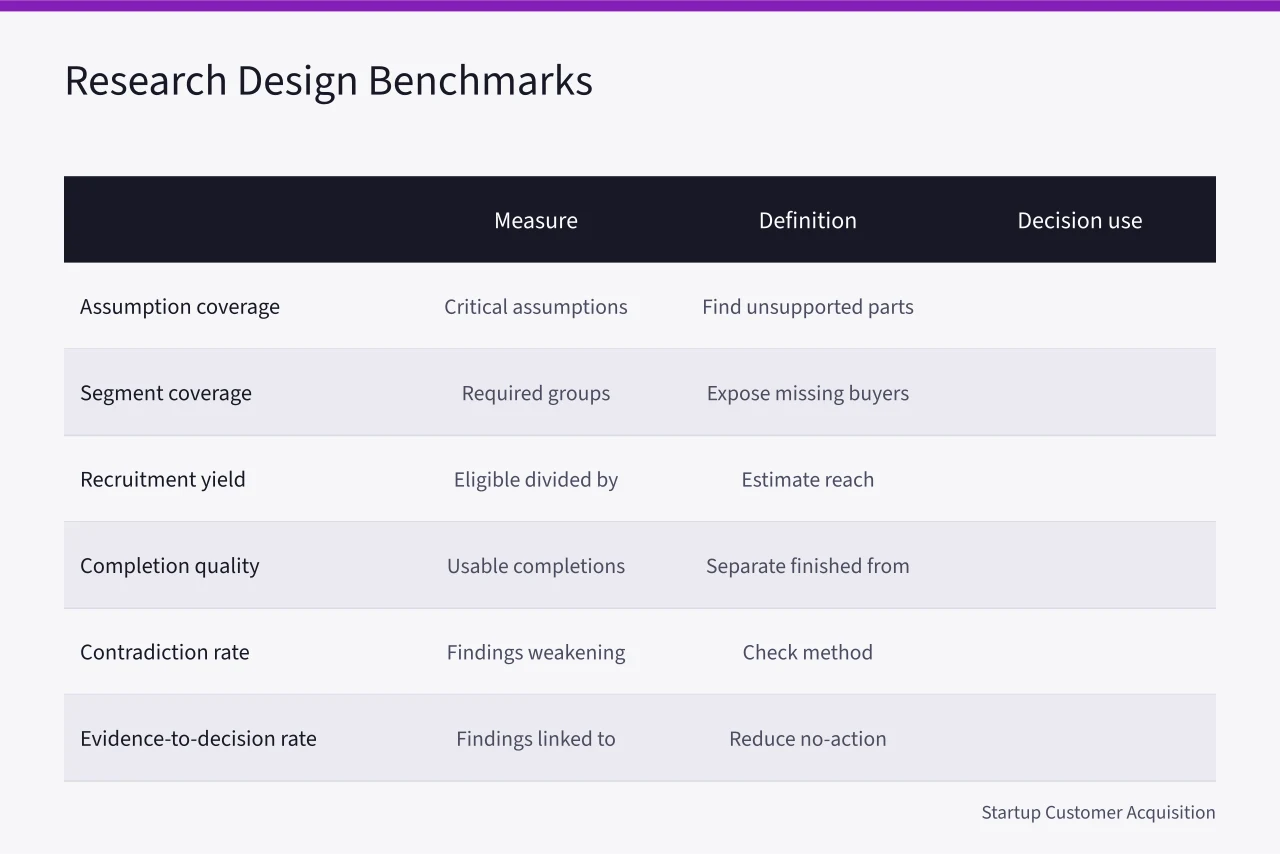
| Measure | Definition | Decision use |
|---|---|---|
| Assumption coverage | Critical assumptions with at least one suitable evidence method | Find unsupported parts of the decision |
| Segment coverage | Required participant or data groups represented in the study | Expose missing buyers, users, non-adopters, or geographies |
| Recruitment yield | Eligible participants divided by people screened or contacted | Estimate reach and identify overly broad recruiting |
| Completion quality | Usable completions meeting attention and eligibility rules | Separate finished records from decision-ready evidence |
| Contradiction rate | Material findings that weaken a stated assumption | Check whether the method can challenge the idea |
| Evidence-to-decision rate | Research findings linked to a documented product or market choice | Reduce reports that produce no action |
| Behavior progression | Eligible prospects taking the predefined next commitment | Test whether interest becomes action |
| Learning cycle time | Days from decision question to documented conclusion | Match research speed with decision reversibility |
Report survey numbers with context
Record invitations, eligibility, contacts, starts, completions, removals, sample source, modes, incentives, field dates, weighting, exclusions, and missing groups. Precision and response claims must match the sampling method and stated formula.
Benchmark secondary data quality
Track sources with complete metadata, current measured periods, comparable geographies, resolved classifications, uncertainty, and documented revisions. A convenient dashboard does not remove the need to inspect each field's source, date, definition, and comparability. Source metadata matters most when the benchmark feeds a startup market research question about timing or market sizing.
Benchmark interview evidence
Track eligible segments reached, recent events described, artifacts reviewed, buyer roles included, negative cases, and material contradictions. Do not use interview count alone.
Add customer and ethics guardrails
A research cycle should not be called successful if it produces a fast answer through misleading recruitment, undisclosed recording, unsafe data handling, or sales outreach disguised as research. Track notice exceptions, withdrawal or deletion requests, access violations, missing consent records where required, and unapproved reuse.
Use internal baselines
Compare research cycles by decision type and maturity rather than averaging every project. Establish a baseline for recruitment time, completion quality, unresolved critical assumptions, experiment cost, and decisions changed. A faster study is not better if it excludes the budget owner or hides negative cases.
Keep a 2027 benchmark record
Save the formula, source, owner, cohort, inclusions, exclusions, and threshold for every number. The 2027 label identifies the editorial and operating period, not a universal market standard. Preserve prior definitions so changes in methods do not masquerade as changes in customer behavior. A startup market research checklist keeps the formula, source, owner, and threshold attached to every number.
Quick comparison
| Benchmark family | Useful measure | Misleading shortcut |
|---|---|---|
| Sources | Current, comparable fields | URL count |
| Participants | Required roles and negative cases | Interview total |
| Quality | Exclusions and unresolved risk | Completion rate alone |
| Decision | Action changed or stopped | Positive conclusion |
Test whether two public estimates really differ
The Census Bureau's ACS Statistical Testing Tool supports statistical comparisons of ACS estimates and margins of error. Use the matching year, geography, table, and estimate rather than treating any numerical difference as meaningful.
Make the comparison reproducible
The GAO evaluation design guide connects evaluation questions with evidence needs and design choices. Apply that discipline to startup market research benchmarks; federal evaluation guidance does not make a local marketing result causal or transferable.
The NIST experimental design selection guidance begins design choice with the objective and practical constraints. It supports separating startup market research benchmarks reporting from controlled effect estimates, not turning observation into causation.
Common questions
How many interviews should a benchmark require?
No universal number. Track coverage of decision-relevant roles, recent events, contradictions, and whether new evidence changes the next action.
Should survey completion rate be a quality score?
No. Recruitment, coverage, identity, eligibility, exclusions, item quality, attrition, and inference also matter.
What is the best internal benchmark?
Compare similar decision types and maturity stages using stable definitions, then record why any method or threshold changed.