Operations
Part of Startup positioning: a focused business guide for 2027
Which startup positioning questions come up most
Common startup positioning questions for 2027 cover customer scope, alternatives, categories, proof, testing, ownership, names, rollout, and review timing.
What to take away
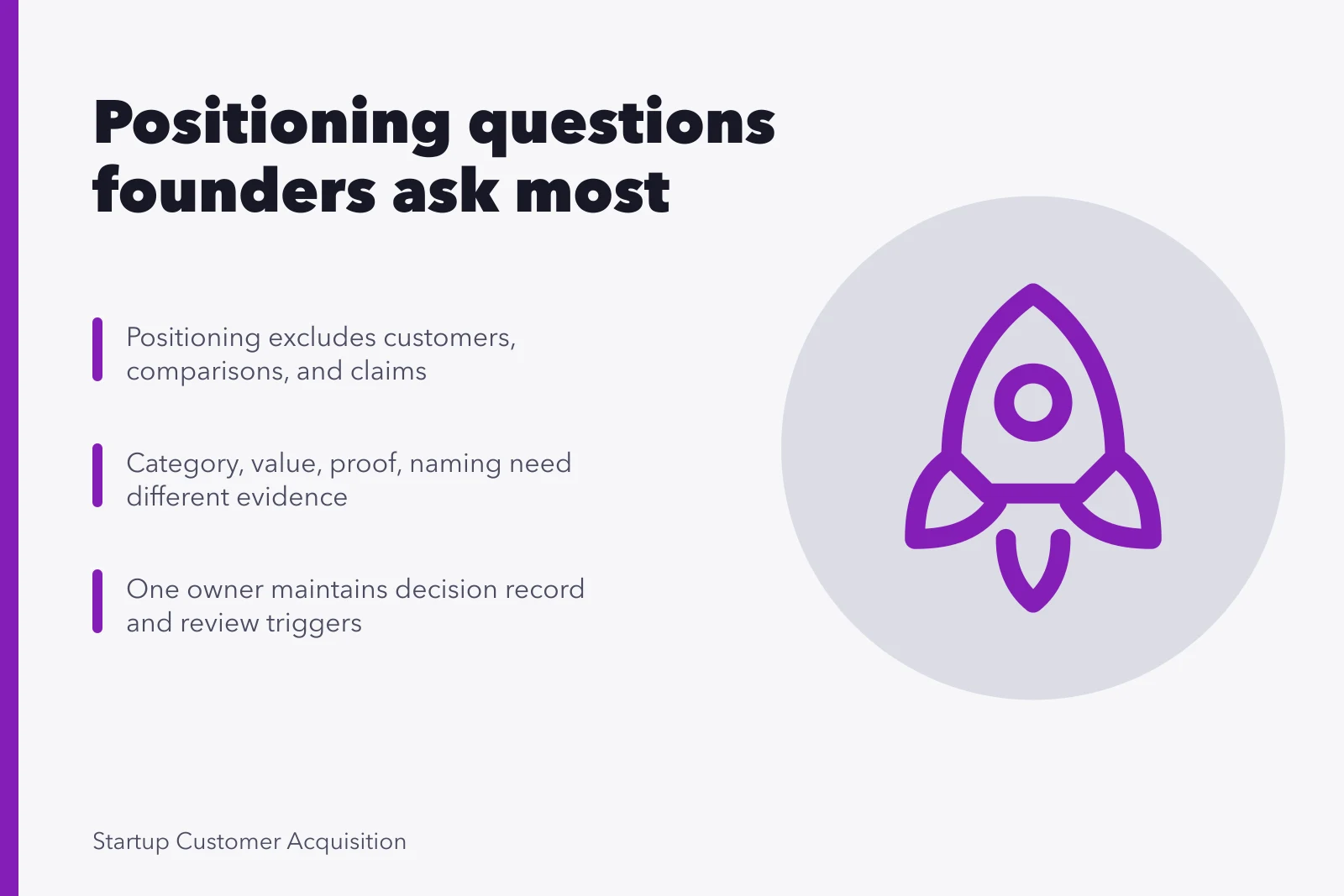
- Positioning is a documented strategic choice. A position is useful only when it excludes some customers, comparisons, and claims.
- Category, value, proof, and naming are separate decisions with different evidence needs.
- One owner should maintain the decision record and trigger a review when assumptions change.
Common startup positioning questions usually appear when a team must choose a customer, a comparison, and a claim. The answers below treat positioning as a documented view of customer, situation, alternatives, market context, differentiated value, and proof.
Ranked by how often they block a first draft:
- Should we start with the product or the customer?
- Who counts as a competitor?
- Is positioning the same as a tagline?
- How narrow should the position be, and can we hold two segments?
- How do we know a claim is safe to use?
The ranking follows decision order, not a survey. A team cannot settle proof before it settles the customer.
Make positioning cross-functional
Product, sales, support, and research each hold part of the evidence about customers and alternatives. Collect it before a position is fixed, and give one leader the decision.
Is positioning the same as a tagline?
No. Positioning sets the context in which a product should be understood and compared. A tagline is a short creative expression. Several headlines can express one position, and a campaign line can change without changing the underlying customer, category, value, or proof.
Positioning vs Tagline
Positioning
- What it sets
- Context for comparison
- How many
- One underlying position
- Can change alone?
- No
- Core elements
- Customer, category, value, proof
Tagline
- What it sets
- Short creative expression
- How many
- Several headlines possible
- Can change alone?
- Yes, campaign line
- Core elements
- Wording only
Before: "We are the modern platform for growing teams." After: "We help independent pharmacies with one pharmacist match dispensing records to plan rules before a claim is filed."
Both lines are illustrations, not claims about a company. The second names a customer, a situation, an alternative, and a proof path. The first names none.
Should we start with the product or customer?
Start with both product truth and customer evidence. Product-only work tends to list features. Customer-only work can promise value the startup cannot deliver. Identify customers who receive unusual value from current capabilities, then examine the situation, alternatives, outcome, and constraints that explain it.
Test: name one customer group that already gets an unusual result from the current product, and one group that does not. If you cannot name both, you have a feature list, not a position.
Who counts as a competitor?
Include what customers would use or do without the startup: direct products, internal work, spreadsheets, agencies, or bundled tools. Also consider postponement or no action.
Build the list from customer interviews, not from a vendor category page.
A competitive analysis of market share and indirect competitors is one of the common startup market research questions teams ask first.
Can a startup target several segments?
It can, but different segments may have different triggers, buyers, comparisons, and value. Write separate segment evidence before combining them. If one position requires contradictory categories or proof, choose a primary segment or create product-level variants while keeping the company promise coherent.
How do we know a claim is safe to use?
Maintain a claim file containing wording, likely implication, evidence, population, method, date, caveat, and approval owner. Review images, demonstrations, comparisons, omissions, and qualifications as well as literal words. Specialized categories can require additional review.
Illustrative row:
Claim safety
- Wording
- Matches dispensing records to plan rules
- Evidence
- Pilot site notes and a time log
- Population
- Independent pharmacies with one pharmacist
- Caveat
- Pilot only, no control group
- Owner
- Head of product marketing
- Review
- Next site report or a plan rule change
Who should own positioning?
One accountable leader should make the decision with focused input from product, sales, marketing, customer success, research, and legal or compliance when relevant. Document disagreements and the evidence needed to revisit them.
When should positioning be reviewed?
Set event-based triggers: new segment, material product change, repeated loss pattern, pricing shift, regulation. Also new substitute, acquisition, persistent customer misunderstanding.
A calendar review helps, but evidence should trigger action sooner, so preserve prior versions for traceability, not rewritten history. Put event-based triggers in a startup market research checklist so reviews happen when evidence changes, not just on a calendar.
Quick comparison
Decision record
- For whom?
- Buyer, user, trigger, exclusions
- Compared with what?
- Real current alternatives
- Why believe it?
- Claim, evidence, caveat
- When review?
- Named event or threshold
Weak answer
- For whom?
- Everyone
- Compared with what?
- Competitors only
- Why believe it?
- Testimonial alone
- When review?
- Once a year
Trademark checks and the decision record
The likelihood of confusion depends on similarity of marks and related goods or services. Positioning research does not replace a full clearance process or qualified legal advice.
The GAO evaluation design guide connects evaluation questions with evidence needs and design choices. The same discipline applies to a positioning decision: name the evidence before the conclusion. Federal evaluation guidance does not make a local marketing result causal or transferable.
The W3C Privacy Principles statement gives web-system designers shared privacy concepts and warns against shifting privacy work to individuals. Where a position touches personal data, the governing law and configuration still decide.
Keep one decision record, written as an ADR-style entry: title, status, context, decision, consequences, owner, and the trigger that reopens the question.
Example entry: question, the primary buyer. Decision, the pharmacist-owner. Evidence, discovery and pilot notes. Owner, head of product. Reopen, a plan rule change.
Common questions
How narrow should positioning be?
Narrow enough that the customer, situation, alternatives, value, and proof are coherent, while the segment remains reachable and serviceable.
Can one startup have several positions?
Yes, when distinct products or buying situations require different comparisons, proof, or delivery promises. Keep the relationship explicit.
Should customers write the positioning?
Customers supply evidence about their situations and alternatives. The company remains responsible for the strategic choice and its consequences.